

In a staggering display of digital audacity, the education technology sector faced its most significant security crisis in years this past May. Instructure, the parent company of the ubiquitous learning management system (LMS) Canvas, found itself locked in a high-stakes standoff with the prolific cybercriminal syndicate known as ShinyHunters. The incident, which saw the hijacking of the platform’s primary login portals, left millions of students and faculty members across nearly 9,000 institutions in the United States in a state of academic paralysis during the critical final exam season.
The breach, which escalated from a private data theft into a public spectacle of extortion, has ignited a fierce debate regarding the fragility of the digital infrastructure supporting modern education and the efficacy of corporate transparency in the face of ransomware.
The Chronology of a Crisis: From Infiltration to Capitulation
The trajectory of the Canvas breach was not a singular event, but rather a methodical, multi-stage assault that caught the EdTech giant off guard despite prior warnings.
Phase 1: The Proof of Concept (September 2025)
Security analysts, most notably Dipan Mann of the firm Cloudskope, argue that the May 2026 crisis was the culmination of an eight-month campaign. In September 2025, ShinyHunters exfiltrated thousands of sensitive internal documents from the University of Pennsylvania, including donor records and private memos. At the time, the incident was localized as a Penn-specific issue. However, evidence suggests that the breach was facilitated through an access path mediated by Instructure’s infrastructure, a fact that would become the blueprint for future attacks.
Phase 2: The Initial Breach (May 1–6, 2026)
On May 1, ShinyHunters successfully breached Instructure’s environment, prompting the company to announce that the incident had been “contained” by May 2. Instructure’s Chief Information Security Officer, Steve Proud, maintained that the impact was limited to basic identifying information—names, emails, and student IDs—and explicitly stated that no sensitive financial or government data had been compromised.
Phase 3: The Public Defacement (May 7, 2026)
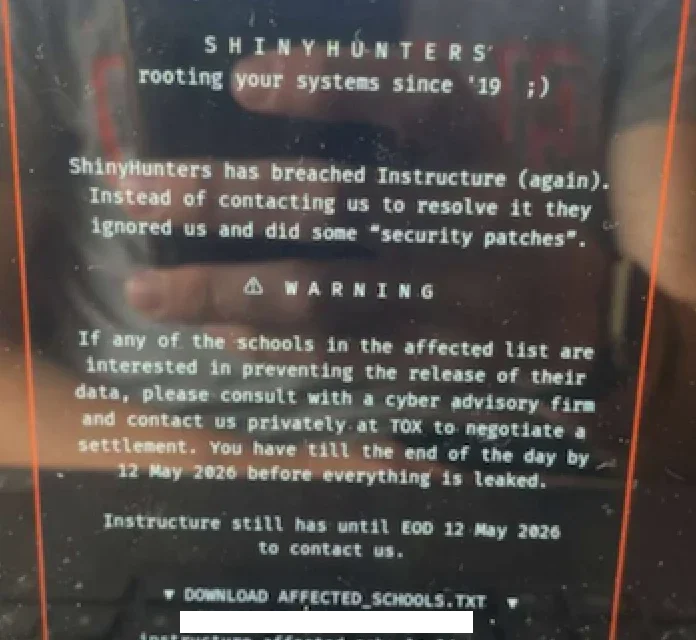
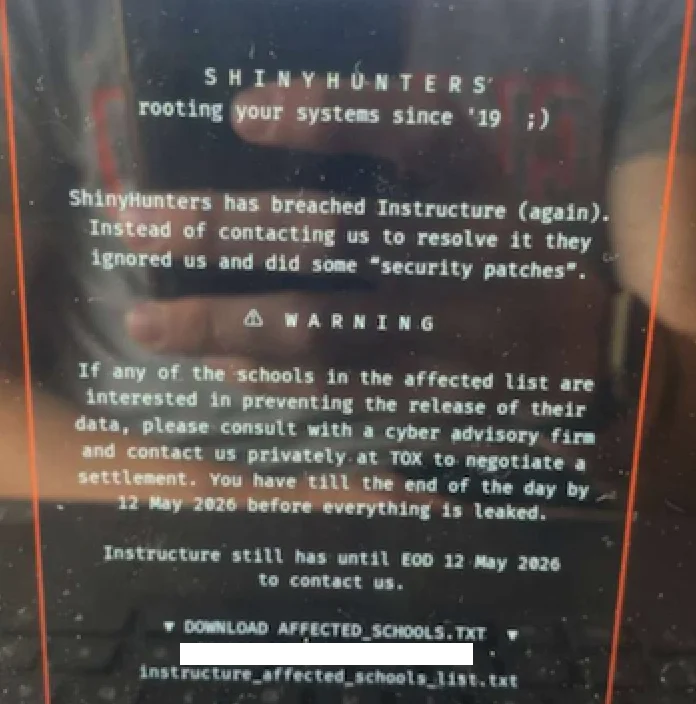
The illusion of containment shattered on the morning of May 7. Students and faculty attempting to log into Canvas were met not with their course dashboards, but with a brazen extortion message from ShinyHunters. The hackers accused Instructure of ignoring their initial communications and failing to implement effective security patches. The message threatened the public release of data belonging to 275 million users unless a ransom was paid. Instructure responded by pulling the platform offline, euphemistically labeling the massive outage as "scheduled maintenance."
Phase 4: The Resolution (May 11, 2026)
Following days of mounting pressure from both the public and institutional clients, Instructure issued a final update. The company confirmed that it had entered into negotiations with the extortionists and paid an undisclosed sum in exchange for the destruction of the stolen data. The company claimed to have received "digital confirmation" (shred logs) verifying the deletion of the information.
The Modus Operandi: Who are ShinyHunters?
ShinyHunters has cemented its reputation as one of the most dangerous and fluid cybercriminal entities currently operating. Unlike traditional ransomware groups that focus on encrypting files for a quick payout, ShinyHunters specializes in data extortion—stealing massive troves of sensitive information and threatening to leak them on the dark web to destroy a company’s reputation and client trust.
Their tactics are characteristically low-tech but high-impact. They rely heavily on social engineering and voice phishing (vishing), where they impersonate IT personnel or trusted internal staff to gain initial access to corporate systems. This was the same methodology they utilized in their recent breach of the home security giant ADT, where they compromised an employee’s Okta single sign-on account to access internal Salesforce databases, exposing the data of 5.5 million customers.
The group’s footprint is global and broad, with credit claimed for breaches against high-profile entities such as Medtronic, Rockstar Games, McGraw Hill, and the cruise line operator Carnival. Their strategy is to identify the “weakest link”—often the human element—to penetrate secure environments, and then exploit the victim’s desperation to keep the breach quiet.
The Controversy of "Scheduled Maintenance"
The most significant criticism leveled against Instructure during the crisis was its attempt to manage the narrative. By labeling the platform’s forced shutdown as "scheduled maintenance," the company faced accusations of misleading its institutional partners.
Dipan Mann of Cloudskope was particularly scathing in his assessment. "Instructure was the mechanism," Mann wrote in his post-mortem analysis. "The May 7 re-compromise was ShinyHunters demonstrating publicly that the May 2 ‘containment’ did not happen."
For many universities and K-12 districts, the lack of transparency was more damaging than the outage itself. Academic administrators, responsible for maintaining the integrity of final exams, were left to navigate a vacuum of information while students panicked on social media. The incident has raised critical questions about the responsibility of SaaS providers to be transparent about security vulnerabilities, especially when those vulnerabilities impact the education of millions.
Implications for the EdTech Sector
The Canvas incident serves as a grim case study for the entire education technology industry. As schools and universities become increasingly reliant on cloud-based platforms for every facet of their operation, they are inadvertently centralizing their risk.
1. The Vulnerability of "Free-for-Teacher" Accounts
Following the breach, Instructure acknowledged that the entry point for the attackers was an issue related to "Free-for-Teacher" accounts. The company ultimately made the difficult decision to temporarily suspend these accounts. This highlights a classic tension in the tech industry: the desire to provide accessible, low-friction entry points for users often creates "shadow IT" environments that lack the robust security oversight of enterprise-grade systems.
2. The Normalization of Ransom Payments
Instructure’s decision to pay the ransom has sparked a debate among cybersecurity ethicists. While the company stated that the payment ensured no customer data would be extorted publicly, critics argue that paying ransoms fuels the criminal economy, ensuring that groups like ShinyHunters continue to target institutions. The "path of least resistance," as Mann noted, is all too often the one that leads to payment rather than long-term hardening of systems.
3. The Need for Proactive Communication
The chaotic response of May 7–8 proved that in the digital age, crisis communication is as important as technical remediation. When a platform as essential as Canvas goes down, silence—or worse, inaccurate status updates—triggers a wildfire of speculation. Institutions are now reassessing their disaster recovery plans, with many demanding more rigorous Service Level Agreements (SLAs) that mandate immediate, transparent disclosure during security incidents.
Conclusion: A Wake-Up Call for Digital Infrastructure
The ShinyHunters campaign against Instructure was not just a breach of a database; it was a breach of trust. By holding the coursework and personal data of hundreds of millions of students hostage, the attackers highlighted how vulnerable the modern academic experience is to a single point of failure.
As of late May 2026, the systems are back online, and the company maintains that the stolen data has been destroyed. However, the reputational damage and the questions surrounding the adequacy of Instructure’s security posture remain. For schools and universities, the incident is a sobering reminder that in the interconnected world of EdTech, security is not merely an IT concern—it is a foundational requirement for the continuity of education itself. Whether the industry learns from this "production run" of an attack, or continues to treat each breach as a localized, quiet matter, remains to be seen. The precedent has been set, and the target on the education sector’s back has never been larger.
